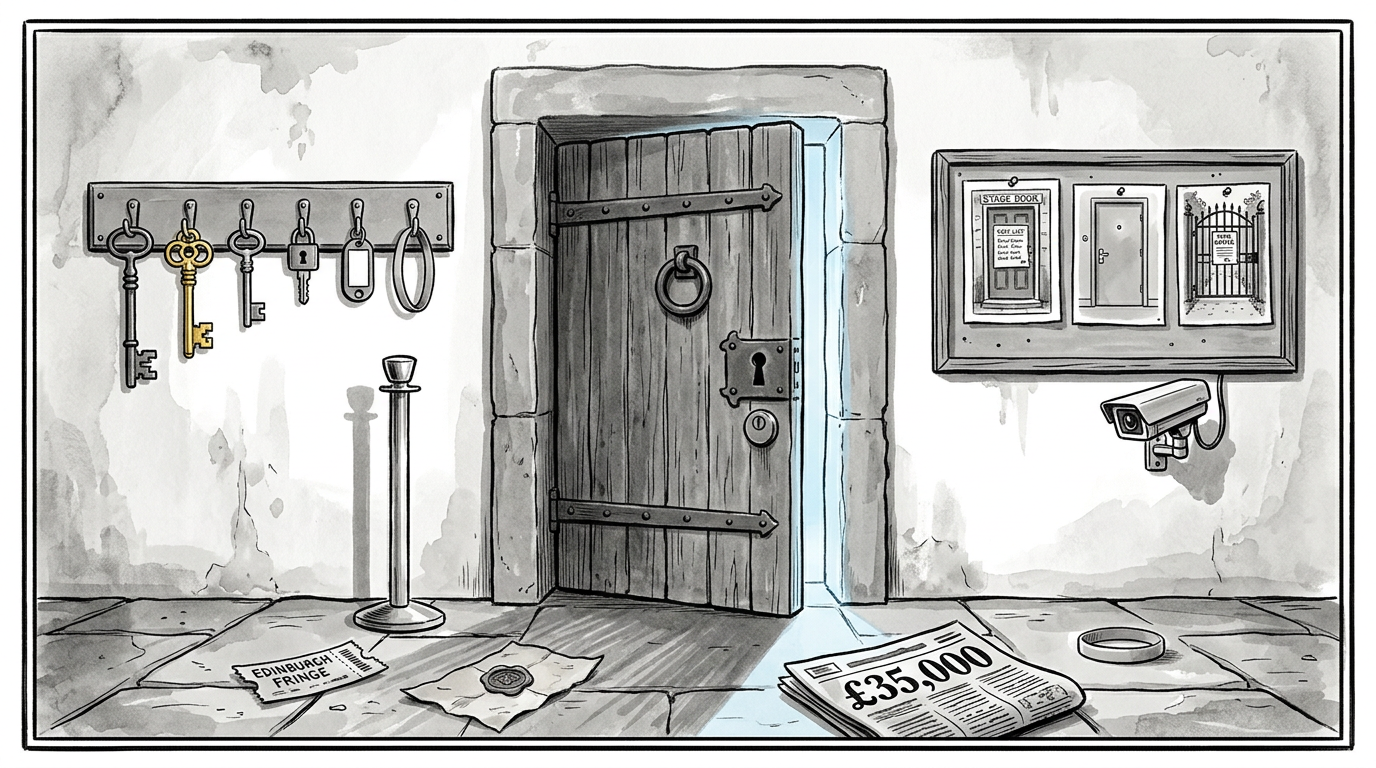
In August 1947, eight theatre companies arrived in Edinburgh uninvited. The official Edinburgh International Festival, curated by impresario Rudolf Bing to restore post-war European culture, had no room for them. They hired their own halls, performed at the margins, and gave the movement its name: the Fringe.[1]
By 1958, the movement had constituted itself formally. The new Festival Fringe Society wrote one founding principle into its charter: it would never vet its programme. No curation. Anyone could come.[1:1]
The logic was clean. Media theorist Clay Shirky spent a career documenting how digital tools destroy unnecessary gatekeeping. His formulation: filter-then-publish was the old regime; publish-then-filter is the new one.[2] He was right. His argument won. Wikipedia replaced Britannica. Open source won most markets where it competed. The specific gates Shirky was fighting — legacy media gatekeepers, copyright incumbents, editorial pre-selection — were protecting incumbents, not quality. Removing them created value.
Media scholar danah boyd named what followed when the same logic reached social media: context collapse.[3] When all audiences receive the same broadcast simultaneously (employer, family, strangers), the norms that governed differentiated context stop working. Opening the media gate closed the context gate. What stayed was more participation. What went was context.
Today, a typical company needs around £35,000 to run a full Fringe production.[4] Venue hire, accommodation, marketing, salaries. The festival born from anti-establishment rebellion, from the deliberate refusal to be curated out, has become one of the most expensive doors in the arts to walk through.
Nobody banned the small companies. Nobody changed the rules. The gate came back through economics.
There is no best level of openness — only gates designed for their purpose. Open one gate fully and a second one forms where you weren't looking. The Fringe's founders designed their editorial gate deliberately. Their economics gate they left to chance.
What the bouncer protects
The bouncer is a gift. Not only to the people inside, but also to the people waiting outside. He is the reason the space is worth entering.
The ratio
David Chapman, a philosopher and cognitive scientist who maps how subcultures decay, spent years documenting the mechanism.[5] A community, a music scene, a niche forum: "geeks" creates something with genuine shared context. "Marginal ordinary people" arrive, attracted by what exists but less committed to maintaining it. "Sociopaths" follow, extracting value before moving on. The ratio that sustains a living community is roughly six casuals to one creator. Past ten to one, the system stops functioning.[6]
Philosopher and mathematician Olivier Rey sharpens the question: not what is this space for, but what is its size?[7] Size determines whether shared context can be held at all.
Most good places already have one
The people most vocal about the injustice of gatekeeping already practice it. The BIPOC healing circle that doesn't accept white participants is doing exactly what it should. The feminist book club with a women-only policy is protecting the thing that makes the space work. The conservative fraternal order with membership criteria is doing structurally the same thing the progressive mutual aid network does when it asks "are you aligned with our values?" The Clefs d'Or, the international concierge association founded in Paris in 1929, admits members only through peer sponsorship and years of verified mastery.[8] The golden keys on the lapel mean something because the door is not open to everyone.
What voluntary means
Alexis de Tocqueville, the French diplomat who spent eighteen months observing American democracy at close range in the early 1830s, noticed the underlying logic: voluntary associations are how democracy learns to organize itself, but they work because they are voluntary, which means selective.[9] Robert Putnam, the Harvard political scientist who wrote Bowling Alone, confirmed it empirically two centuries later: bonding capital, the trust and safety built within a group, is not a lesser form of social capital. It is its own necessary category, distinct from bridging capital and not replaceable by it.[10]
When curation is absent entirely, the result is always the same. Decay.
Bouncing done wrong
The bouncer can also wreck the room.
Philosopher and social critic Ivan Illich called the mechanism counterproductivity: past a certain threshold, a tool produces the opposite of its intended goal.[11] Schools produce credential-seekers who can't think. Hospitals produce patients who can't be well without treatment. Curation that has drifted from its purpose follows the same logic. The gate does not protect the space. It becomes the instrument of its destruction.
When the model is the gate
In 1994, Long-Term Capital Management assembled the most credentialed team in the history of finance: Nobel laureates in economics Myron Scholes and Robert Merton, senior traders from Salomon Brothers, the men who had rewritten financial theory. The fund's stated goal was superior risk-adjusted returns through arbitrage. The filter it applied was rigorous: everyone shared the same mathematical framework.
In August 1998, Russia defaulted. The fund lost 44% of its value in a single month and required a $3.65 billion Federal Reserve-orchestrated bailout from fourteen institutions. The deeper problem: Wall Street had been running the same trades, often with LTCM itself as the counterparty.[12] The filter that was supposed to protect quality had produced a monoculture that amplified a single point of failure across the entire system.
Philosopher John Stuart Mill diagnosed the mechanism a century earlier: truth emerges from competition, not from consensus. "If all mankind minus one, were of one opinion, and only one person were of the contrary opinion, mankind would be no more justified in silencing that one person, than he, if he had the power, would be justified in silencing mankind."[13] LTCM filtered the voices that might have said the models were wrong. The echo chamber did not protect the fund's goal. It guaranteed its failure.
Psychologist Irving Janis documented the pattern across a career studying intelligence failures: Pearl Harbor, the Bay of Pigs, the Challenger disaster. Cohesive groups that suppress internal dissent produce worse decisions than groups that don't, regardless of the individual intelligence of their members.[14] The filter for ideological alignment, applied to a thinking space, destroys the raw material the space processes.
Tradition as cover
Augusta National Golf Club was founded in 1933 and maintained what it called "tradition": no Black members until 1990, no women until 2012. When Martha Burk of the National Council of Women's Organizations challenged the women's exclusion in 2002, club chairman Hootie Johnson responded: "There may well come a day when women will be invited to join our membership, but that timetable will be ours and not at the point of a bayonet."[15]
Augusta is a world-class golf club. The curation that makes it excellent (competitive course design, high standards, serious investment) has nothing to do with the race or gender of its members. The gate was not protecting the quality of golf. It was protecting the comfort of the people already inside.
The quality institution that forgot quality
Medieval guilds began as genuine quality mechanisms: they trained apprentices, standardized craft, and protected consumers from fraudulent goods. By their peak, they had become something else. Economic historian Sheilagh Ogilvie's empirical research found that guilds "negatively affected quality, skills, and innovation" and "persisted not because they benefited society, but because they enriched powerful guild members and the political elites who protected them."[16] Long apprenticeships, which could have taken years, were extended to delay competition. Women, Jews, and the rural poor were systematically excluded from trades they were qualified to practice.
This failure mode is structurally distinct from Augusta: the gate started by protecting purpose and drifted. It is also more common. When a space's actual curation no longer matches its stated goal, examine the gap. The curation reveals the real purpose. These failures have a common structure: the wrong filter was applied to the wrong dimension.
The platform that refused the door
In late 2023, Substack came under pressure for hosting neo-Nazi and white nationalist publications. Its founders defended the position on free speech grounds, arguing the platform would not become "the arbiter of truth."[17] Several prominent writers, including Roxane Gay, left the platform in protest. The reasoning was Shirky's: publish-then-filter, let the audience decide.
The second-order gate nobody designed: a platform's moderation stance is itself a signal. Hosting neo-Nazi content alongside serious journalism does not leave all writers equally neutral. It produces an association cost that falls specifically on writers who care about where they publish. The openness did not remove the gate. It moved it from the platform's terms of service to each writer's calculation about whether to stay.
Ghost, the open-source publishing platform, made the opposite call. Its acceptable use policy explicitly prohibits content promoting hatred, discrimination, or violence.[18] That closes a gate. The writers Ghost loses are those the policy covers. The writers it keeps decided the constraint was worth publishing within.
Bluesky separated the question architecturally. The AT Protocol, the open specification underpinning the network, treats moderation as a composable layer.[19] The protocol is open; communities and applications apply their own filters on top of the shared infrastructure. The gate at the protocol layer stays open. The gate at the community layer is designed by the community. What Substack treated as a binary becomes a design space. Open source at the protocol level is not the same as an open gate at the content level.
Designing the bouncer
No neutral arrangement
Berghain, the Berlin techno club operating in a former power plant since 2004, is probably the most studied example of designed curation in the world. Sven Marquardt, its head bouncer, selects not for demographics but for energy and intent.[20] The queue stretches for hours. Rejection is common and expected. Inside: no photographs, near-total darkness, a specific kind of freedom. The selection creates the atmosphere it protects. The curation and the experience are the same thing.
Legal scholar Cass Sunstein calls this choice architecture: there is no neutral arrangement of options.[21] Open one gate and the pressure moves to the next. The question is not how open — it is which gates this design produces and whether those are the ones you want.
Which dimension?
A person is simultaneously a race, a gender, a cognitive framework, an expertise level, a level of commitment. Gatekeeping always operates on some subset of those dimensions. The design question is which dimensions are relevant to this space's goal.
A healing space filters on shared experience: race, gender, trauma history. Cognitive homogeneity is not a liability. The BIPOC circle that excludes white participants has correctly identified the dimension that matters for its purpose.
A thinking space filters on commitment and genuine intellectual openness. Complexity scientist Scott Page demonstrated mathematically that diverse groups of problem-solvers outperform homogeneous groups of individually smarter people, because diversity of cognitive approach matters more than individual excellence.[22] LTCM filtered for mathematical agreement and got catastrophic correlated failure.
A craft community filters on mastery level. Everything else is noise. The Clefs d'Or don't ask who you are. They ask what you can do: whether you know which florist answers at midnight, how to source a table on a Saturday when nothing is available, whether you can get a guest into a sold-out show an hour before curtain. The golden keys signal that someone has demonstrated exactly that, in practice, over years.
Who holds the dial
Putnam's framework becomes a design tool here. Every community needs some balance of bonding capital and bridging capital, but the right ratio depends entirely on what the community is for.[23] Applying bonding logic to a thinking space produces echo chambers. Applying bridging logic to a healing space produces the Castro pattern: well-intentioned visitors who consume the context they came to experience.[24]
The Ostrom principle governs the rest: those affected by the rules must be able to participate in modifying them.[25] Nobel Prize-winning political economist Elinor Ostrom showed across decades of fieldwork that sustainable communities are not those with the most elegant rules but those where the people subject to the rules hold the dial. Augusta's women members arrived in 2012 not because the gate served its purpose but because external pressure finally overrode incumbent comfort.
Stop debating how open the gate should be. Start asking which gates this design produces, and whether those are the ones that serve the purpose.
The gate matters less than the infrastructure it sits on. Berghain controls its criteria because it owns the building. The Fringe controls its admissions policy but has no jurisdiction over Edinburgh's accommodation market. Designing the gate is necessary but not sufficient: hold it only if you hold what it's attached to.
Back to Edinburgh.
The eight companies who performed in hired halls in 1947 were not against curation. They were against being curated out of a festival they had every right to participate in. They built their own door with their own budget, outside the official programme, in defiance of a gate that had excluded them.
Seventy-five years later, their door costs £35,000 to walk through.
Nobody designed that gate. The economics of success (the venues, the PR machine, the accommodation market) built it while everyone was celebrating the Fringe's openness. Political theorist Langdon Winner called this the politics of artifacts: values encoded in systems that no one explicitly designed.[26] The anti-vetting principle survived intact. The £35,000 threshold arrived without anyone writing it down.
That is what accidental curation looks like. The context that made the space worth entering was left to be priced out by forces that were not wrong to exist, but whose combined weight, at scale, rebuilt the barrier.
And the next time you feel excluded, ask the same questions — not as an accusation but as a diagnostic.
A gate is not fate.[27] The bouncer is not the problem. Designing him badly is.
Edinburgh Festival Fringe — History. The 1958 constitution's explicit non-vetting principle is also documented in History.com's account of the 1947 founding. ↩︎ ↩︎
Clay Shirky, Here Comes Everybody: The Power of Organizing Without Organizations (Penguin Press, 2008): "Filter-then-publish, whatever its disadvantages, offers a relatively clean answer to the question 'How do we tell the good from the bad?' The new answer is publish-then-filter." ↩︎
Alice Marwick and danah boyd, "I tweet honestly, I tweet passionately: Twitter users, context collapse, and the imagined audience," New Media & Society 13:1 (2011): 114–133. ↩︎
The true cost of performing at the Edinburgh Fringe (The Scotsman, 2025). Breakdown of a typical production: £10K accommodation, £10K artist salaries, £10K marketing, £5K production costs. ↩︎
David Chapman, "Geeks, MOPs, and sociopaths in subculture evolution" (Meaningness, 2015). ↩︎
David Chapman, ibid.: "The optimal mop:geek ratio is maybe 6:1; above 10:1 the system usually breaks down." ↩︎
Olivier Rey, Une question de taille (2014): "La question de la taille est sans doute la question la plus importante que l'on puisse poser à une société. Non pas: à quoi sert-elle?, mais: quelle est sa taille?" ↩︎
Les Clefs d'Or, official history: lesclefsdor.org. The French association was founded November 27, 1929, when Pierre Quentin convened Paris hotel concierges; the international union was formalized on April 25, 1952, at the Carlton Hotel, Cannes. Membership requires sponsorship by two active members. ↩︎
Alexis de Tocqueville, Democracy in America, Vol. II, Part 2, Chapter 5 (1840); trans. Harvey C. Mansfield and Delba Winthrop (University of Chicago Press, 2000): "Americans of all ages, all conditions, all minds constantly unite together... wherever at the head of some new undertaking you see the government in France, or a man of rank in England, in the United States you will be sure to find an association." ↩︎
Robert D. Putnam, Bowling Alone: The Collapse and Revival of American Community (Simon & Schuster, 2000), Chapter 1: "Bonding social capital is good for undergirding specific reciprocity and mobilizing solidarity... Bridging networks, by contrast, are better for linkage to external assets and for information diffusion." ↩︎
Ivan Illich, Tools for Conviviality (1973), Chapter 1: "Beyond a certain threshold of intensity, industrial production of services paradoxically produces the opposite of its intended goal." ↩︎
Roger Lowenstein, When Genius Failed: The Rise and Fall of Long-Term Capital Management (Random House, 2000). On the fund's model failure, Epilogue: "Unlike dice, markets are subject not merely to risk, an arithmetic concept, but also to the broader uncertainty that shadows the future generally. Unfortunately, uncertainty, as opposed to risk, is an indefinite condition, one that does not conform to numerical straightjackets." ↩︎
John Stuart Mill, On Liberty (1859), Chapter 2: "If all mankind minus one, were of one opinion, and only one person were of the contrary opinion, mankind would be no more justified in silencing that one person, than he, if he had the power, would be justified in silencing mankind." ↩︎
Irving L. Janis, Victims of Groupthink: A Psychological Study of Foreign-Policy Decisions and Fiascoes (Houghton Mifflin, 1972), Chapter 1: "The more amiability and esprit de corps there is among the members of a policy-making in-group, the greater is the danger that independent critical thinking will be replaced by groupthink, which is likely to result in irrational and dehumanizing actions directed against out-groups." ↩︎
Hootie Johnson, Augusta National Golf Club statement (2002), as reported by Sports Illustrated and Golf Digest: "There may well come a day when women will be invited to join our membership, but that timetable will be ours and not at the point of a bayonet." ↩︎
Sheilagh Ogilvie, "The Economics of Guilds", Journal of Economic Perspectives, Vol. 28, No. 4 (2014), p. 174: "Guild membership usually required town 'citizenship,' a costly privilege enjoyed by less than half the inhabitants of a typical premodern European town. Most guilds also excluded Jews, bastards, migrants, laborers, farmers, propertiless men, former serfs and slaves... and those who couldn't afford the admission fees." ↩︎
Hamish McKenzie, Chris Best, and Jairaj Sethi, "Regarding Substacks with content many find objectionable," Substack Notes (December 21, 2023). [VERIFY exact title and date] The founders' response was widely covered: see Casey Newton, "Substack has a Nazi problem," Platformer (November 28, 2023). ↩︎
Ghost Foundation, Acceptable Use Policy: ghost.org/acceptable-use. The policy explicitly prohibits "hate speech and discrimination," "harassment and threats," and related categories. ↩︎
Bluesky Social, "AT Protocol Overview," atproto.com. The protocol separates infrastructure (open, federated) from moderation (composable: communities and applications apply their own labeling and filtering via the Ozone tooling). ↩︎
Sven Marquardt, interview, Mixmag (2015), via Dancing Astronaut: "It's subjective... Beyond that, there are no set rules." The "energy and intent" formulation is an interpretive summary; Marquardt consistently describes a subjective, instinct-based reading of whether someone understands Berghain's atmosphere. ↩︎
Cass Sunstein, Nudge: Improving Decisions About Health, Wealth, and Happiness (Yale University Press, 2008), Chapter 1: "A choice architect has the responsibility for organizing the context in which people make decisions... there is no such thing as a 'neutral' design." [VERIFY exact wording — paraphrase of core thesis] ↩︎
Scott E. Page, The Difference: How the Power of Diversity Creates Better Groups, Firms, Schools, and Societies (Princeton University Press, 2007), Prologue ("How Diversity Trumps Ability"). The formal mathematical result: Lu Hong and Scott E. Page, "Groups of Diverse Problem Solvers Can Outperform Groups of High-Ability Problem Solvers," PNAS 101:46 (2004): 16385–16389. ↩︎
Robert D. Putnam, Bowling Alone (2000), Part 4: "Bonding social capital constitutes a kind of sociological superglue, whereas bridging social capital provides a sociological WD-40." ↩︎
Vincent Jones II and Laurie Essig, "Bachelorette parties in P-town often destroy safe spaces for LGBTQ+ people," The Boston Globe, August 8, 2022. The researchers term this process "hetrification." Their documentation covers Provincetown, MA; the Castro's parallel trajectory is widely reported in San Francisco Bay Area journalism. ↩︎
Elinor Ostrom, Governing the Commons: The Evolution of Institutions for Collective Action (Cambridge University Press, 1990), Chapter 3, Design Principle 3: "Collective-choice arrangements: Most individuals affected by the operational rules can participate in modifying the operational rules." ↩︎
Langdon Winner, "Do Artifacts Have Politics?" Daedalus 109, No. 1 (1980): 121–136: "The things we call 'technologies' are ways of building order in our world. Many technical devices and systems important in everyday life contain possibilities for many different ways of ordering human activity." ↩︎
Andrew Feenberg, Transforming Technology: A Critical Theory Revisited (Oxford University Press, 2002): "Technology is not a destiny but a scene of struggle." ↩︎