How did I become a PM?
So you know where my advice comes from.
I started working as a PM a few months after my graduation in 2018. Two very different persons pointed me each to a different founder of the same company.
The two founders were generous enough to give me a job. The reasons being a mix of my multidisciplinary background (law, business, tech), the recommandation of former teammates, the reputation of my business school, my passion for legaltech and my interviewing skills.
Once you have the “product manager” job title and hold it for a few years, it gets much easier.
 Florian Herlicq
Should you become a PM?
It’s up to you but you should have the facts.
What are good reasons / bad reasons to be a PM?
✅ Impact. Being passionate about making an impact / improving a situation. You have more ownership on impact than most non-leadership roles.
✅ Problems. Loving solving problems. If you select problems that have an impact, you are golden. Because you will have to solve a ton of them. Best to enjoy it.
✅ Design. Like an architects “designs” a house. You will have to combine a lot of different expertises in a creative way.
✅ Entrepreneurship. You want to be an entrepreneur but don’t want to take the risk. In some context (early stage, high agency / empowered team), being a PM is a watered down version. Less autonomy, less risk.
❌ Salary. Salary is quite high. But if you are not passionate about making an impact / improving people’s situation, it will eat your soul because of the constant need to say “no” or balance impossible constraints. There are better paying jobs with less stress.
❌ Status. In some places being a PM is a status symbol. But more often than not you are also the person who says ‘no’ a lot. The person who no one quite knows what they do. The “project manager”.
 Lenny Rachitsky
What is the job of a PM?
Short answer: Mortar person responsible of moving the tech team in the right direction to achieve the company strategy. A mix of diplomat, detective, architect, orchestra conductor, inspector and advocate.
Long answer:
There are product managers in many industries (Cosmetics, Cards, etc.). Tech is just one type, but as software is eating the world, so are software product managers.
Making sure the ressources of the company are being used to build the right thing
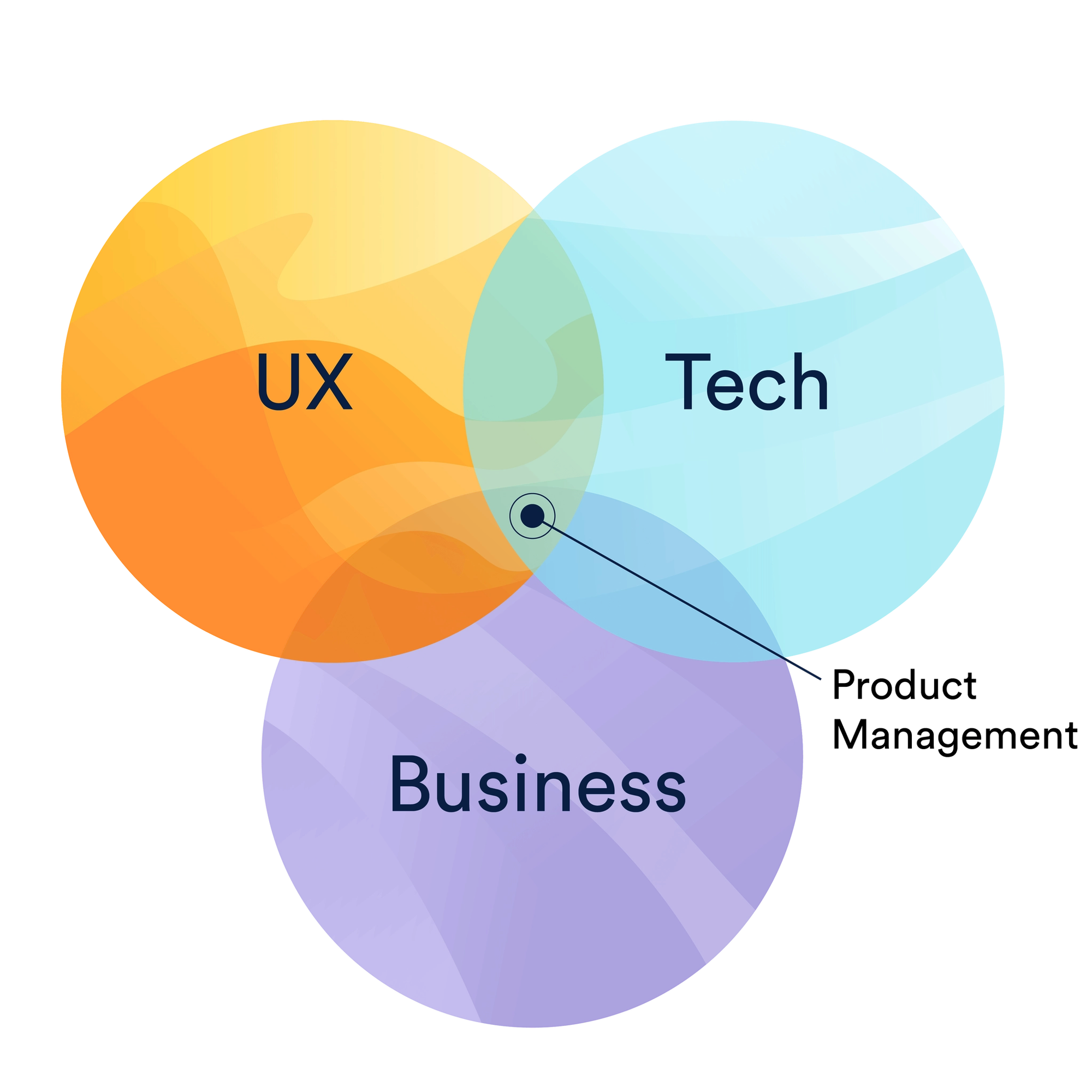
Most of the time this means :
- Discovery : talking to users & internal stakeholders to understand the priorities & problems (discovery)
- Delivery : talking to the design & tech team to build a solution, then following up with to make sure it is being built on time with the right level of quality
- Go to market : Aligning with marketing / growth / care / sales to make sure the new feature gets the traction it deserves
But the exact scope, tools and tasks changes a lot based on the culture / organisation of the company. It can even vary in the same company based on the stage it is at.
To do that you need to be good at : User research, Data analysis, UX design, Tech literacy / understanding technical stuff (but not doing it), Project management, stakeholder management, marketing management…
Although most of the time your colleagues will be much better at their particular speciality than you are, you need to be better than them at everything else to be a bridge.
Is being a PM a good role?
💙 Passion If you are passionate about solving problems and making an impact, it is the best job (after “founder”).
💙 Collaboration You are in a position to interact with everyone in the company. They need you as much as you need them.
💙 Learning Because of the continuous stream of changing project and variety of interactions, you learn a ton.
💙 Salary It pays well. Sometimes even better than developpers. (France 2024 - World 2023)
💔 Stress Tight deadline, ambitious target. Your outcomes depend on other teams outputs. You are between a rock and a hard place. This can be highly detrimental to mental health.
💔 Saying no (a lot) The amount of ideas is much greater than the available ressources.
💔 Misunderstood Most people, even close team member, don’t exactly know what you do. Which can mean a lot of time advocating for your role just to get the job done. And as your job is misunderstood and its scope changes from company to company, it can be hard to exactly be evaluated and know what your exact scope is.
💔 Lagging ressources Ressources in your team are often a percentage of the tech teams ressources. Which means that the tech team grows first, then you feel the pain, then your team grows.
Where can you find a PM job?
Where should you look?
A lot changed in the last few years, with consolidation on job platforms. What is left :
- 🇫🇷 https://www.welcometothejungle.com/fr
- https://www.linkedin.com/
- Recruitement agencies: https://www.pachamama.pm/, https://tpc-recrutement.com/
What kind of company should you join?
- Consider if you want to have a High local impact on your team (small company) vs High market impact (big company)
- Look for mentors. PM is a craft, that you learn along good craftsmen. “Knowing what ‘good’ looks like is an underrated superpower. Many people have learned to cope with bad environments and never have had the chance to participate
Try to understand what kind of product organization they have
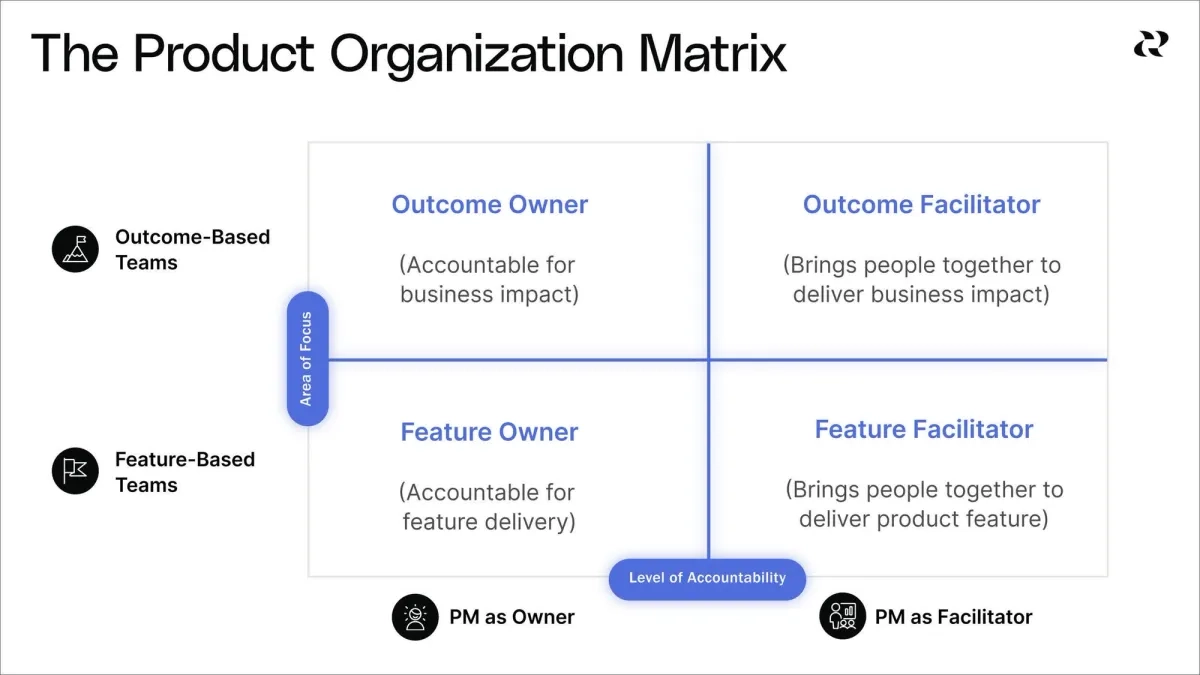
The closer you are to more experienced talented PMs, the money making and the decision making, the better. The hardest is to get into product and not all product jobs have the same effect on career. Don't underestimate the "halo effect" of having a recognisable brand on your resume.
Which means that if you have a choice, you should join (in my subjective order of preference):
- Tech ateliers : small / mid-sized bootstrapped tech companies, companies that care more about doing things right that pure growth, where you learn to do things the right way. Very rare and quite competitive (Ghost, 37signals)
- Scale-up: post Series B, already a team and processes, preferably "recognisable brand". You will learn the most by seeing how "good" gets done.
- SaaS: the product is the software, better alignement
- Fintech: still very technical and decent tech/strategy alignement
- Any other (insurtech, medtech...): also good, but expect some arbitrage in favor of the core business and against the tech for ressources
- Big tech: Also a lot of high caliber PMs, but a lot more politics. Think Apple, Google, Facebook, Amazon.
- Early stage startup as a first PM: Seed / Series A. You will learn by doing, less efficient but more ownership. Same order : SaaS, Fintech, other
- Product/Tech consulting: very good about method, but low ownership (roadmap, ideas) because renewing the client is the main goal, not the product. And clients are often not startups, so you learn to navigate politics early on, more than ownership. Think Thiga, Théodo, Octo Technology, Wivoo. Often a good ways to enter because they are used to having young graduates.
- Established corporation: If you manage a "Product Owner" job, it is still a way in. But there will be an uphill battle if you want to move into "tech" (Big tech or startups) because old school companies tend to do things in a very different way. No serious tech companies does "Scrum" for example.
 Lenny Rachitsky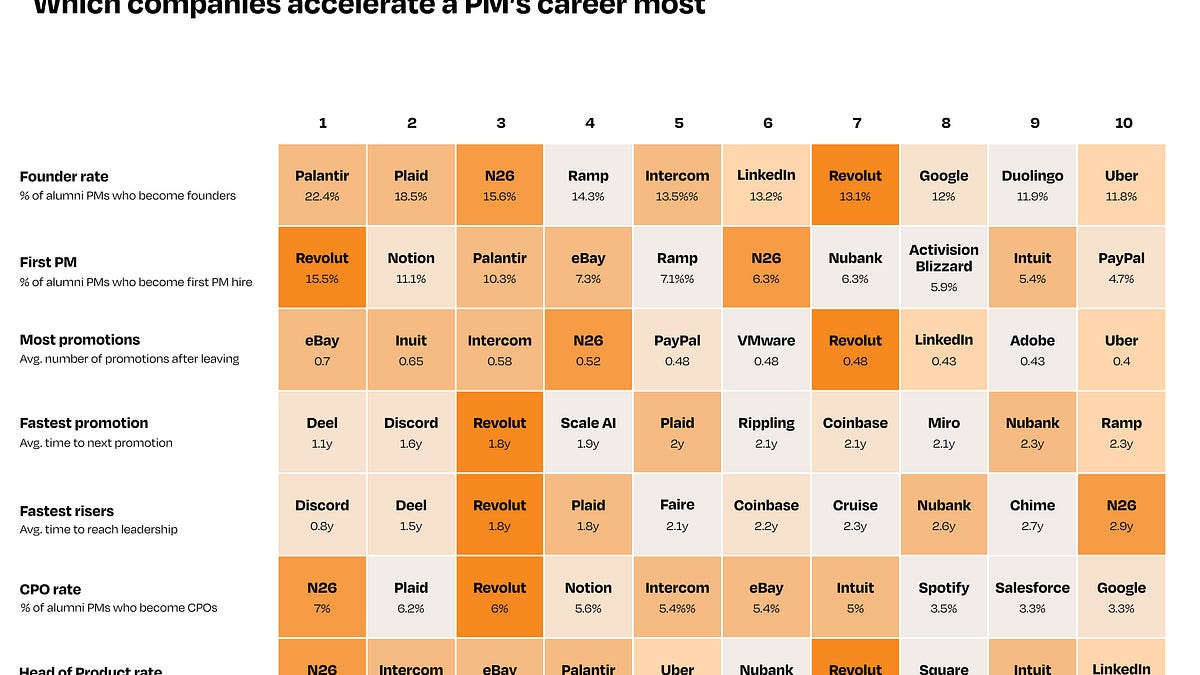
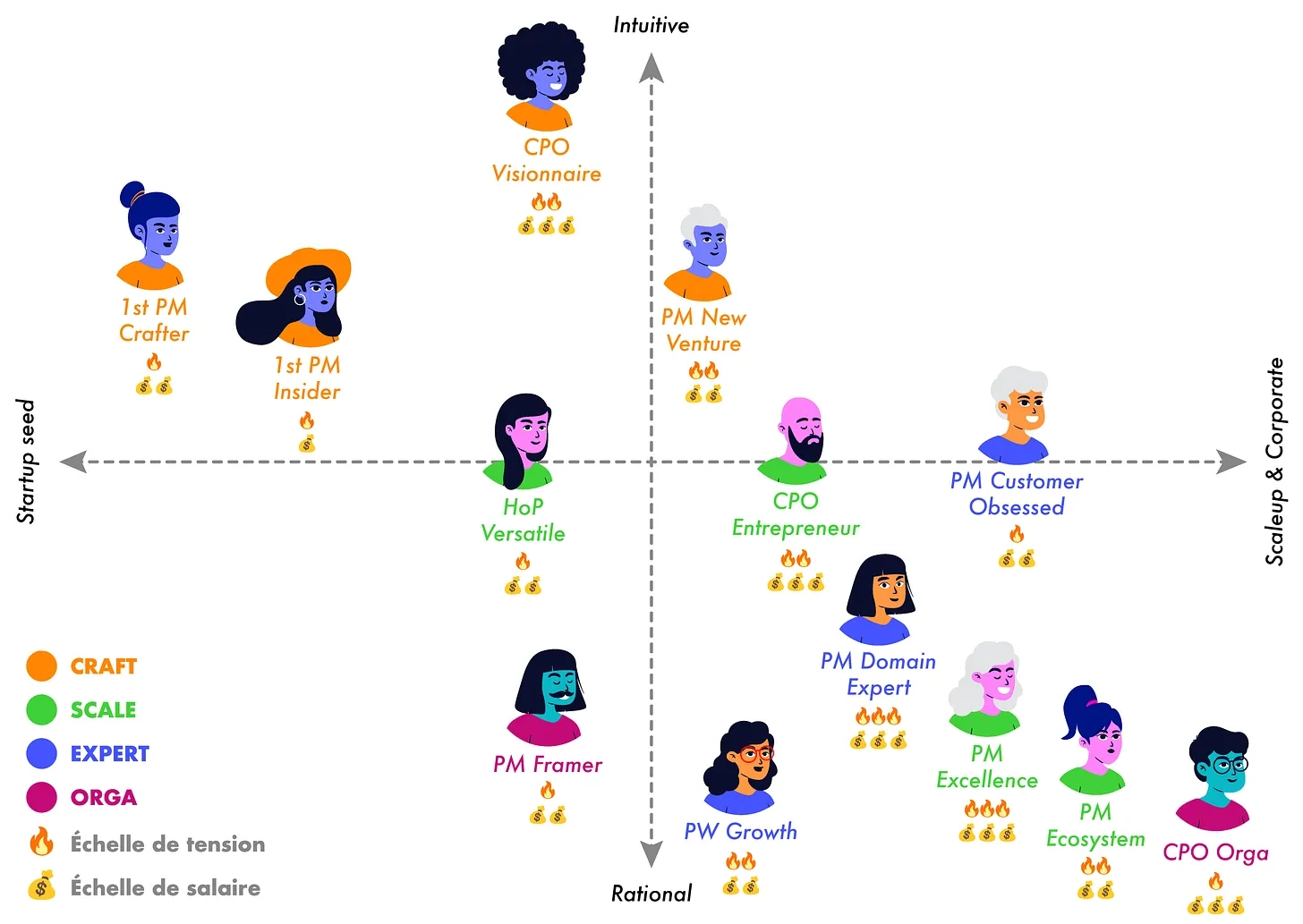
What kind of product manager ?
- You will be a junior at first.
- But then you can specialize :
- Industry (fintech, health tech, etc…)
- Product type (SaaS, Marketplace, etc…)
- Domain (growth, mobile, integrations…)
- Company size (1st PM, Organization…)
- And progressively decide if you want to grow your career as :
- Individual contributor: Become an expert and hone your individual skill
- Manager: learn to leverage others and help them grow
How can you prepare for a PM job?
Get the basics
- Learn the basics. Get to know the lingo, the frameworks, the tools. PMs love to debate prioritization methods, defining “quality” rather than doing the (needed) QA, etc.
- Then let go of the basics, because your company/team does not care.
- Try to find the first principles behind them. Try to understand the motives and assumptions of frameworks to see if they fit your need. For example “Scrum” is not inherently bad but you will only know when to use it if you examined it critically.
Online courses & certifications → Get an overview of the job
Treat online courses & certifications the same. Companies don’t care about certifications. Only do them if the content appears worth it.
The one I used in… 2017. Still the best-seller though.
Also :
- https://www.reforge.com/
- https://productschool.com/certifications/product-manager-certification
Bootcamps → Take a (optional) shortcut
Much like coding bootcamps, there are now bootcamps specialized bootcamps to become a Product Manager.
They were a great investment in 2020, when there were more job offers than decent candidates. Now that the “junior” jobs have mostly disappeared, it is a harder sell because they cost a lot of money.
But it is a good shortcut if you have the time & money. And they have decent recognition (compared to certifiations that have slim to none).
Fill your skills gap
Inspired by https://www.ravi-mehta.com/product-manager-roles/
The online course should cover a lot of the basics, but you should want to dig deeper.
Business management
As you may know, there are multiple year curriculum about that topic. But not all business school courses are useful as a product manager. If you don’t come from a business background, you should consider investing heavily into that to become a great PM. No course recommandation here.
- Business strategy Defining a general plan to have an impact under uncertain conditions.
- Business modeling You should have a notion of what profits, costs, revenue, etc. are. Because you build for the business and in the end move one of those metrics. And then work on it in a spreadsheet.
- Strategic marketing You will be a product manager. As such, you should understand what a “product” is and where the notion comes from. And how it interact with a brand, a marketing mix, acquisition channels, etc.
Technical literacy
Same as business. Very big topic. You should not be the one building, but you should know enough to be a valuable contributor to the discussion. Enough to challenge and evaluate what is being said. In my case I did a coding bootcamp for that (https://www.lewagon.com/)
👉🏻 There are a broad list of things you need to consider.
- Minimum : Read articles about “Technical skills for PMs” that give a digest (like this one or this one)
- Ideal : Go do the basics of an online coding bootcamp (ex codecademy) to learn about frontend, backend, git, APIs, databases, etc.
Design & user research
Good user experience makes for a good product. You should have a good judgement in that matter. Also, the product design will be one of your closest collaborator, so you have to learn to work wit them.
- Design Design basics (by figma) Figma is to product designers what photoshop is to photographs. Their course blends generic notions and tool specific tutorials. Learn both and you will become better.
- User research Read “The mom test” by Rob Fitzpatrick
Project management
As a PM, you will be the de facto project manager for a collection of projects impacting your product. Each new feature is a project. A big discovery campaign is a project. A Beta for a new feature is a project.
👉🏻 Learn actual project management and the specificities of agile :
- Google project management 🆓 Never done it myself. But it is free and has awesome reviews.
- Agile project management (by google) 🆓 Never done it myself. But it is free and has awesome reviews. It talks a lot about scrum (and scrum is a cancer), but you will find scrum remnants everywhere (user stories, dailies…) so it is useful to know.
Data analysis
Understanding your product will often means pulling structured (and unstructured) data from various sources : data tables, BI dashboards, behavioral analytics…
Product analytics ex with https://posthog.com/tracks
SQL to query databases https://www.codecademy.com/learn/learn-sql
Product culture
A bit part is to follow the ecosystem (see below). But don’t skip on day to day observation of the apps you use, the software at your work and anything that may have been prioritized by a PM at a moment.
👉🏻 Look for (and understand why) apps & software :
- Your favorite
- The one you hate but can’t stop using
- The most aestetically pleasing
- The most addictive
- The one worth paying for
- Etc.
Follow the ecosystem
Social media → Know your influencers
Mostly on twitter or linkedin :
- linkedin.com/in/lennyrachitsky/
- linkedin.com/in/teresatorres/
- linkedin.com/in/johnpcutler/
- linkedin.com/in/melissajeanperri/
- linkedin.com/in/shreyasdoshi/
- linkedin.com/in/cagan/
- linkedin.com/in/florianherlicq (me)
- And many many many more.
Newsletters→ Keep up with the latest trends
💸 Paid – 🆓 Free – 🇺🇸 In English - 🇫🇷 In French - 🗓️ Multiple times a week - 1️⃣ Once a week - 2️⃣ Every two weeks - 📅 Once a month
Lenny's newsletter 💸 1️⃣ 🇺🇸 by Lenny Rachitsky
A must-read for product managers and startup enthusiasts, Lenny Rachitsky’s newsletter offers deep insights into product development, growth, and tech company culture. Leveraging his experience from Airbnb, Lenny shares actionable advice, industry interviews, and case studies.
Productverse 🆓 📅 🇬🇧 by Olivier Courtois
Once a month, a curated list about product management. What I really like is that the list is more about guides and actionable articles than about news. Also, it is written by a French product leader, so it hits closer to home.
Pachamama 🆓 1️⃣ 🇺🇸 by Marion Darnet
Marion does an amazing job at analyzing the trends in the recrutement market for Product people. Her views are often original and valuable, especially at a time where the tech job market is not so good.
SVPG 🆓 2️⃣ 🇺🇸 by Marty Cagan
The silicon valley product group is the OG newsletter about product management and the "Product Model". Expect very focused and opinionated articles about what the "good" way to build tech-powered products. Important to understand the doxa of PM community.
TL,DR Product 🆓 🗓️ 🇺🇸
Same as TL,DR but focused on product management.
Le ticket 🆓 1️⃣ 🇫🇷
A nice mix of small link summaries and a long form article about product management. Another way to keep in touch with the french PM ecosystem.
Prepare the hiring process
Noam Segal
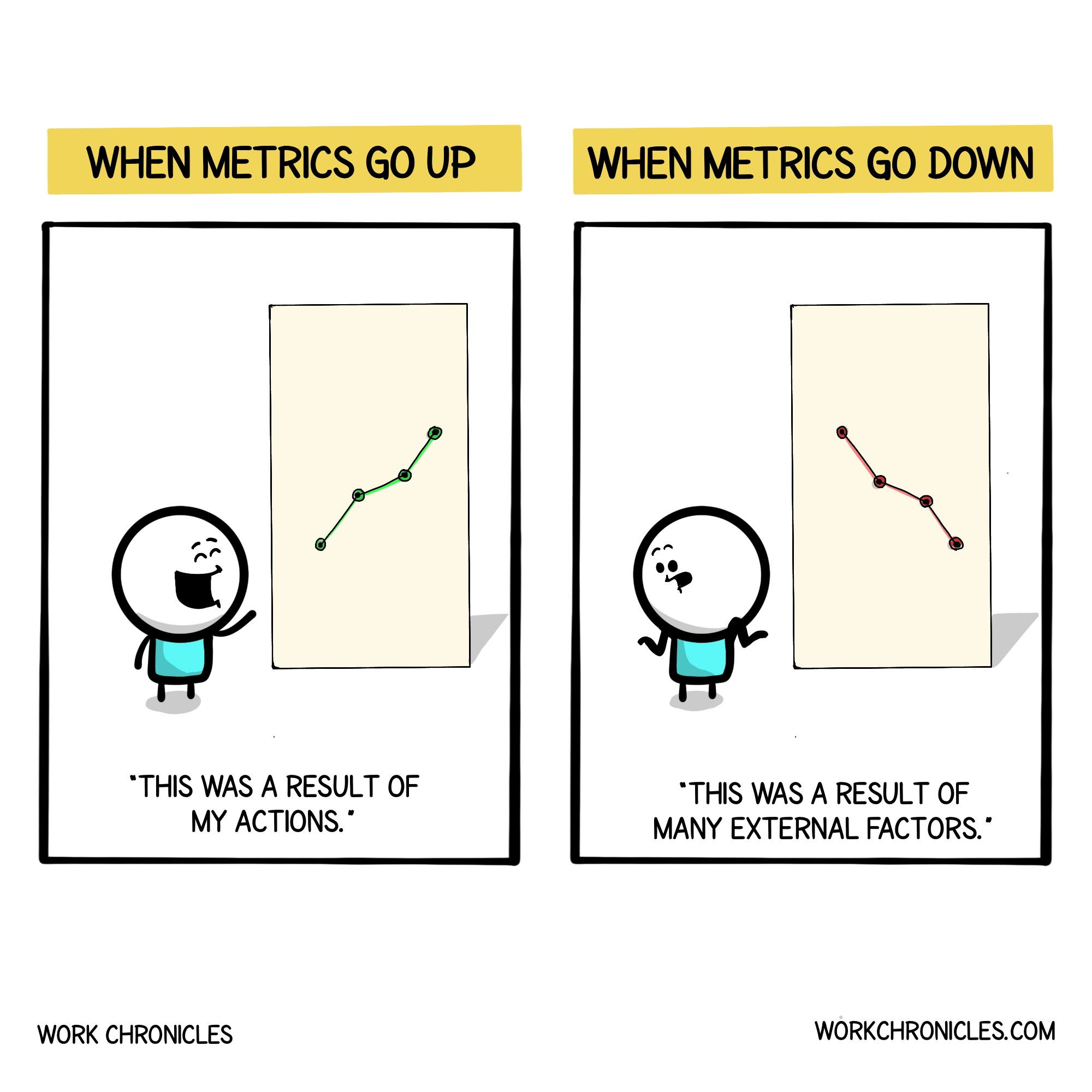
Funny-ish stuff.
Great example of (bad) product management
@tldv.io PM math is not regualr math #productmanagement #developer #tech #startup #corporate #customersuccess #aitools
♬ original sound - tldv.io - AI Meeting Recorder